
Town of The Blue Mountains – 2026 Municipal Election
A Voter’s Guide to Assessing Candidates for Town Council
The 2026 Town of The Blue Mountains municipal election will shape how the community manages growth, infrastructure, housing, tourism, taxes, environmental stewardship and public trust.
Voters will elect a Mayor, Deputy Mayor, Councillors and School Board Trustees, with voting available by internet and telephone during the voting period from October 16 to October 26, 2026.
Use this guide to judge candidates on what matters most: whether they understand the council’s role, can explain real trade-offs and are prepared to make accountable decisions for the whole municipality. The four pillars below offer a practical framework for comparing campaign promises, debate answers and door-to-door conversations.
How to Use This Guide
Use the questions, tests and checklist when attending debates, reading platforms, reviewing candidate websites, speaking with candidates at the door or comparing responses after public meetings. The goal is to identify candidates who can turn promises into practical decisions, not simply candidates who agree with you on every issue.
Candidate Evaluation Checklist
Before reviewing the four pillars in detail, use this quick matrix to assess candidates during debates, campaign conversations and platform reviews:
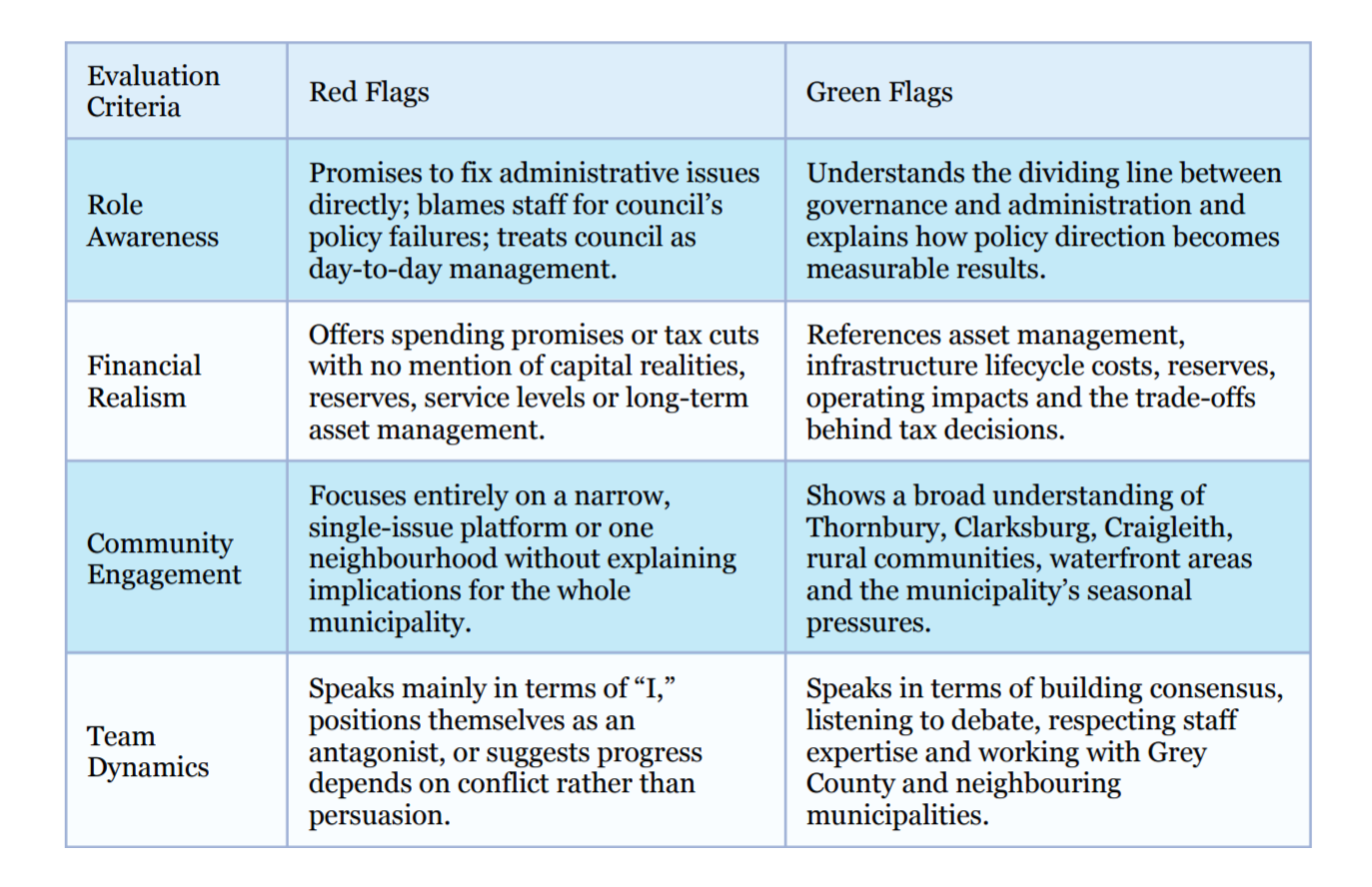
1. Governance Mindset vs. Operational Mindset
A common campaign weakness is confusing council’s governance role with staff’s operational role. Roads, development applications, service complaints, water and wastewater capacity and seasonal pressures all matter, but credible candidates explain how council can address them through policy direction, budget approval, service standards and oversight.
The Test: Does the candidate understand that council governs by setting policy, approving budgets, establishing service levels and holding administration accountable rather than managing staff’s day-to-day work?
Look For: Candidates who connect resident concerns to policy tools, measurable outcomes and public reporting, rather than promising to bypass process or treat individual complaints as a substitute for governing well.
Red Flags: Promises to personally fix service complaints, direct staff, override process or ignore governance rules when administrative frustration arises.
2. Fiscal Literacy and Long-Term Stewardship
The Blue Mountains face major financial pressures from aging infrastructure, growth-related capital needs, service expectations from residents and visitors, and long-term asset management. The approved 2026 budget included a 4.34% municipal levy increase and a $345,000 contribution to the Asset Management Reserve, making fiscal literacy a practical test of candidate readiness.
The Test: Can the candidate explain how they would pay for campaign promises, including trade-offs among taxes, fees, service levels, reserves, debt, development charges and capital timing?
Look For: A practical grasp of municipal finance, including asset management plans, operating and capital budgets, infrastructure reserves and lifecycle costs. Be cautious of slogans such as “freeze taxes” or “cut waste” unless the candidate identifies which services, projects or reserves would change.
Red Flags: Promises major tax relief or new spending without naming affected services, capital projects, reserves, debt levels or future operating costs.
3. Collaboration and Decision-Making Style
A councillor has one vote at the table, so results depend on persuasion, preparation and constructive relationships. The Mayor and Deputy Mayor also represent The Blue Mountains at Grey County, making collaboration with council colleagues, staff, neighbouring municipalities, community groups and rights-holders essential.
The Test: How does the candidate handle disagreement, competing neighbourhood priorities and complex files such as growth, housing, transportation, tourism, environmental protection and infrastructure phasing?
Look For: Evidence of collaborative skills in business, non-profits, community committees or public service. In debates and conversations, listen for objective data, active listening and respect for differing views rather than defensive or divisive language.
Red Flags: Frames council as a battlefield, dismisses compromise, relies on grievance language or treats one group’s demands as automatically overriding the municipality-wide interest.
4. Communication and Accessibility
A representative’s job does not end when the council meeting adjourns. In a municipality with full-time residents, seasonal property owners, business operators, farmers, volunteers and visitors, candidates should show how they will explain complex decisions before they become flashpoints.
The Test: Will the candidate translate complex municipal reports, budgets and planning decisions into plain, transparent language before major votes occur?
Look For: Candidates who prioritize accessibility, seniors, housing, public scrutiny and respectful engagement across the whole municipality, including Thornbury, Clarksburg, Craigleith, Ravenna, rural areas and waterfront communities.
Red Flags: Communicates only after controversy arises, avoids difficult trade-offs, or uses vague statements where plain-language explanations are needed.
Local Issues to Listen For in 2026
Use these local issues as practical test cases for the four pillars above. They reveal whether candidates can connect campaign positions to governance, budgets, collaboration and clear communication.
Infrastructure and asset management: Can they explain how roads, bridges, water, wastewater, stormwater, sidewalks and recreation assets will be maintained and funded over time?
Growth and housing: Can they balance housing choice, affordability, rural character, intensification, servicing capacity and neighbourhood fit?
Tourism and local economy: Do they understand the benefits and pressures of being a destination community, including parking, traffic, short-term accommodations, events, seasonal demand and support for local businesses?
Environment and climate resilience: Can they speak concretely about protecting the escarpment, waterfront, agricultural lands, natural heritage, tree canopy and climate-ready infrastructure?
Public trust: Will they strengthen transparent decision-making, proactive consultation and progress reporting aligned with the Town’s 2026–2027 Corporate Strategic Plan?
Questions to Ask Candidates
What should the council decide directly, and what should remain the responsibility of professional staff?
Which campaign promises would require the largest budget trade-off, and how would you pay for them?
How would you balance growth, housing choice, servicing capacity and neighbourhood character?
What infrastructure risks should the next council address first, and why?
How would you communicate a difficult or unpopular council decision before the vote?
How would you work with Grey County, neighbouring municipalities, community groups and rights-holders to get results?
What would success look like at the end of the next council term, and how should residents measure it?
Final Thought
The strongest candidates will not simply promise action; they will show that they understand governance, municipal finance, collaboration, communication and the long-term interests of the whole Town of The Blue Mountains.
A strong vote is not only a vote for familiar priorities; it is a vote for candidates who can make clear, accountable decisions when priorities compete.
